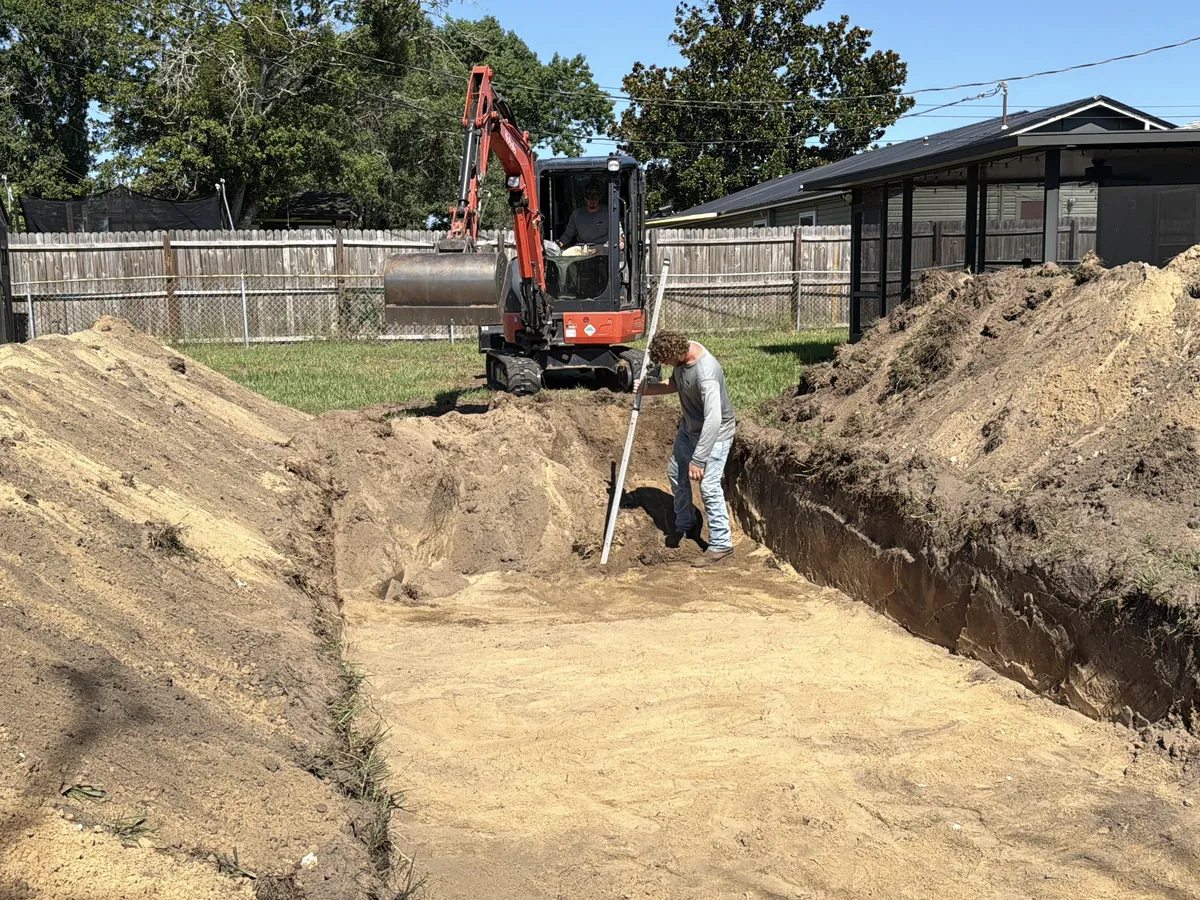
How much does drain field replacement cost in Alabama?
The Septic Guide’s March 2026 cost guide puts a conventional drain field replacement at $5,000 to $15,000. Septic and Well Pro’s June 10, 2026 guide puts a full replacement for a conventional system at $5,000 to $20,000. Soil and bedroom count decide where a job lands in those ranges.
These are published market ranges, and your price comes from a look at your own lot. Drain field, leach field and field lines all name the same buried trenches. Our crews handle drain field repair across Northeast Alabama, and every estimate is free.
What does each level of drain field work cost?
The price starts with how much of the field has failed. Septic and Well Pro’s June 10, 2026 guide splits the work into four levels.
| Scope of work | When it applies | Published range | Cost guide |
|---|---|---|---|
| Minor repair, one line or a blockage | One damaged line, roots in the line, or a partial biomat | $1,500 to $5,000 | Septic and Well Pro, June 10, 2026 |
| Partial replacement, several lines | Part of the field failed, with some soil still usable | $5,000 to $10,000 | Septic and Well Pro, June 10, 2026 |
| Full conventional replacement | Complete failure, with a full permit and install | $8,000 to $20,000 | Septic and Well Pro, June 10, 2026 |
| Alternative system, such as a mound, aerobic unit or chamber field | Poor soil, a high water table or limited space on the lot | $15,000 to $30,000 and up | Septic and Well Pro, June 10, 2026 |
The full replacement row starts at $8,000, above the $5,000 low end of Septic and Well Pro’s June 2026 summary. Septic and Well Pro’s June 2026 guide says alternative systems on difficult soil can push past $30,000. For Georgia, Septic and Well Pro’s June 2026 guide lists a typical replacement range of $1,500 to $15,000 or more.
What goes into a drain field replacement quote?
A full replacement stacks several jobs into one bill. The Septic Guide’s March 2026 cost guide lists every line item you will see on a contractor’s estimate.
| Line item | Published range | Cost guide |
|---|---|---|
| Perc test and site evaluation | $500 to $2,000 | The Septic Guide, March 2026 |
| Engineering or design, if required | $500 to $1,500 | The Septic Guide, March 2026 |
| Excavation and site prep | $1,500 to $5,000 | The Septic Guide, March 2026 |
| Conventional drain field installation | $3,000 to $10,000 | The Septic Guide, March 2026 |
| Chamber system drain field | $4,000 to $12,000 | The Septic Guide, March 2026 |
| Distribution box replacement | $500 to $1,500 | The Septic Guide, March 2026 |
| New septic line, tank to field | $40 to $180 per linear foot | The Septic Guide, March 2026 |
| Landscaping restoration | $500 to $3,000 | The Septic Guide, March 2026 |
The Septic Guide’s March 2026 data says labor accounts for 60 percent or more of the total cost. That is why the digging moves the price more than the pipe does. If a quote skips an item, The Septic Guide says to ask if it is included or billed separately.
Permit fees are not in the table, so check with the county health department for the current amount. A licensed soil professional or the county does the soil evaluation, and we coordinate it. Our guide to Alabama septic permits and perc tests explains that process.
Is a new drain field a repair or a relocation in Alabama?
Alabama’s onsite sewage rules, Chapter 420-3-1 of the Alabama Administrative Code, draw a line between a repair and a relocation. A repair fixes a failing part of a system whose flow and waste strength have not changed. The rule says a repair does not include replacing or relocating the field.
A repair still takes paperwork. A permit to repair has to come from the county health department first, and we handle it. Nobody, homeowners included, may start an install or a repair before that Permit to Install (Repair) issues. Repaired systems get the same inspection and documentation as new systems.
A relocation is a bigger job on paper. A replacement field counts as a new system and has to meet all current rules. When a relocation is required, the applications, plans, certifications, site evaluation and standards match a new system. Before the permit issues, the soil tests must be certified.
The rules define a Replacement Effluent Disposal Field as an area set aside in case the field must be replaced. A repair does not need an additional one. Which side of the line your job falls on can change the price, so check with the county health department. For what a whole new system runs, see our Alabama septic system cost guide.
Public sewer can change the answer. If a failed system cannot be repaired and public sewer is within 500 feet, the house must connect. That connection is subject to approval of the officials in charge.
What drives drain field replacement cost in Alabama?
Soil and house size come first. Alabama’s rule figures the field’s minimum trench area from the bedroom count. The loading rate, or how much water each square foot may take, follows the perc rate. The Septic Guide says slow clay or hardpan means a larger field or an engineered design.
A four bedroom house on slow soil needs far more trench than a two bedroom house on fast soil. The Septic Guide makes the same point: bedrooms and the soil’s perc rate set the field size.
Access and rock come next. Steep slopes, rocky ground, mature trees and tight driveways all make the digging harder. Septic and Well Pro’s June 2026 guide says those can add $1,000 to $5,000 in mobilization and labor alone. Septic and Well Pro also says clay-heavy soil and shallow bedrock push a job toward engineered designs.
State rules set minimum setback distances for fields and tanks, so open space on the lot matters. The Septic Guide says that when an original permit names a reserve area, that is where the new field goes. Losing that area to a building or paving is costly. The Septic Guide’s March 2026 guide puts a job with no reserve area at $15,000 to $50,000.
The tank is the other big question. Septic and Well Pro’s June 2026 guide says replacing the tank with the field adds $1,500 to $5,000. The Septic Guide’s March 2026 guide says keeping a sound tank saves $3,000 to $7,000 over a full system. If the tank is replaced, Alabama sizes the new one by bedroom count.
When both have failed, the job becomes a full septic system replacement. The Septic Guide’s March 2026 guide puts a tank and field together at $8,000 to $20,000. Our post on whether a tank needs repair or replacement covers the tank side.
Some lots cannot take a conventional field at all. The Septic Guide says a mound is required for shallow soil, a high water table or high bedrock. The Septic Guide’s March 2026 guide puts a mound replacement at $10,000 to $20,000. Those lots need an engineered septic system.
Can field lines be repaired instead of replaced?
Sometimes, so the diagnosis comes before the quote. Septic and Well Pro’s June 2026 guide puts a camera inspection of the lines at $200 to $500. The same guide says a camera or a soil probe test can make the repair or replace call.
Some problems only look like a failed field. The Septic Guide’s chart blames slow drains plus an overdue tank on a full tank. Its advice is to pump the tank first and reassess. The same chart ties one wet section, with the rest dry, to a failing or unlevel distribution box.
Real repairs come next. One crushed or root-filled line is a minor repair in Septic and Well Pro’s table. The Septic Guide advises replacing a bad distribution box before committing to a full replacement. Our field line repair page lists the fixes we make.
The Septic Guide’s March 2026 guide puts rejuvenation at $1,000 to $5,000. The methods include soil aeration and jetting the field pipes. The Septic Guide says it works best when the field is struggling but has not fully failed. Once sewage surfaces or backs into the house, The Septic Guide says rejuvenation almost never works.
Septic and Well Pro says that once the biomat has spread across the entire field, repair is off the table. Then the soil needs time to recover, or a new field goes in a different area. We look at the tank and the field lines before we quote the job.
Does homeowners insurance cover drain field replacement?
Almost never. The Septic Guide says drain field replacement is almost never covered by standard homeowners insurance. Its March 2026 guide says standard policies exclude drain field failure as a maintenance issue. Policies cover sudden perils such as fire or fallen trees, which rarely affect drain fields.
How do you protect a new drain field?
The Septic Guide says a new field can match the original’s life if the first failure’s cause is corrected. EPA and the Alabama Department of Public Health (ADPH) give this advice for the field:
- EPA says not to park or drive on your drain field.
- EPA says to keep roof drains, sump pumps and other rainwater drainage away from the field. Excess water slows or stops the treatment.
- ADPH says not to dig in the field, build anything over it, or cover it with concrete or asphalt.
- ADPH says to plant nothing over or near the field except grass. EPA says to plant trees far enough away to keep roots out.
EPA says a tank full of solids can push them into the drain field. The pipes clog and the biomat grows thicker. The biomat is a bacteria layer that forms on the bottom and sides of the trenches.
EPA says household tanks are typically pumped every three to five years. Our guide on how often to pump a septic tank in Alabama covers the schedule that keeps solids in the tank and out of the new lines.
A field that stays soggy after rain may be taking groundwater from uphill. A curtain drain above the field can cut that water off before it reaches the lines.
How do you get a real number for your field lines?
Every range above comes from a published cost guide, and your own lot sets your price. ADPH says state law requires septic tank installers and pumpers to have a license. The company holds the Alabama Level II (advanced) onsite wastewater installer license. That state level covers engineered and large commercial systems as well as conventional ones.
Our three crews dig field line trenches with the company’s own excavation equipment. Decades of septic installs sit behind the company. In Alabama, we handle the permit with the county health department.
We work across Northeast Alabama and Northwest Georgia, from Piedmont out to Gadsden and Fort Payne. We look at the tank and the field lines, then quote the job for free. Call (256) 453-9003 or request a free estimate.